Motivation
The GBS began as a project to provide precise stellar calibration for Gaia as well as for the Gaia-ESO Survey for a wide range of stars. At the early 2010's, only the Sun was used as a common reference star for spectroscopic analysis, but the Milky Way has stars that are very different to the Sun.
In 2014, the GBSv1 were published and comprised of 34 stars, including the Sun. The GBSv2 added a few metal-poor candidates, and revised some of the GBSv1 ones, keeping the number of stars similar to the GBSv1. The latest sample, the GBSv3, has 202 stars, including the Sun, and has been released in 2024. The catalogues include stellar parameters, spectra and chemical abundances of iron-peak, alpha and neutron-capture abundances.
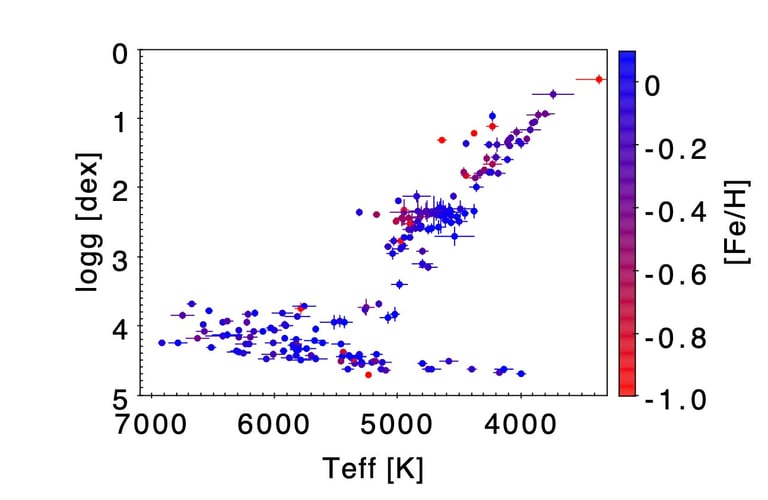
The GBSv3 Kiel Diagram (taken from Soubiran et al. 2024)
What makes a GBS a benchmark star
There are several conditions that the GBS need to satisfy to become a good reference star
Key conditions
Be resolved for interferometric observations for a good angular diameter
Have an accurate parallax
Have accurate photometry for a good bolometric flux
Have a spectrum of an individual and inactive star
Have a spectral class of F, G, K
Current Focus
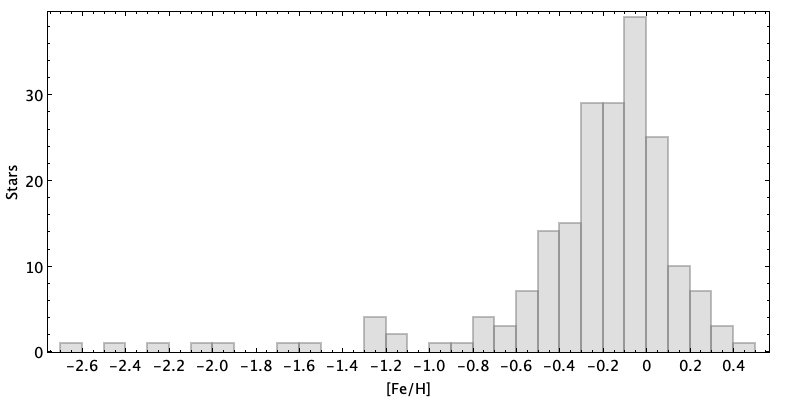
Metallicity distribution of the GBSv3 (Soubiran et al. 2024)
The GBSv3 has used the best interferometric measurements available to date, but we can see there are very few metal-poor stars.
Fundamental Relations
With these conditions we can estimate the stellar parameters using Stefan-Boltzman for the temperature, and Newton for the surface gravity
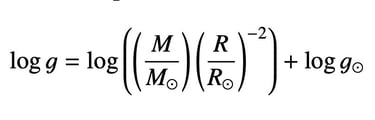
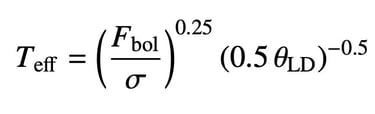
We are assembling a new dedicated catalogue from new interferometric observations of metal-poor stars.
Legacy papers
This is a selection of high-impact (more than 100 cites) papers of our group that were possible thanks to the GBS.
Introduction of the GBSv1: Heiter et al 2015
Metallicity of the GBSv1: Jofré et al. 2014
Alpha and iron-peak of the GBSv1: Jofré et al. 2015
Release of iSpec: Blanco-Cuaresma et al. 2014
Annual Review on stellar abundances: Jofré, Heiter & Soubiran 2019
Gaia-ESO Linelist paper: Heiter et al. 2021