Paper I: Gaia FGK benchmark stars: Effective temperatures and surface gravities
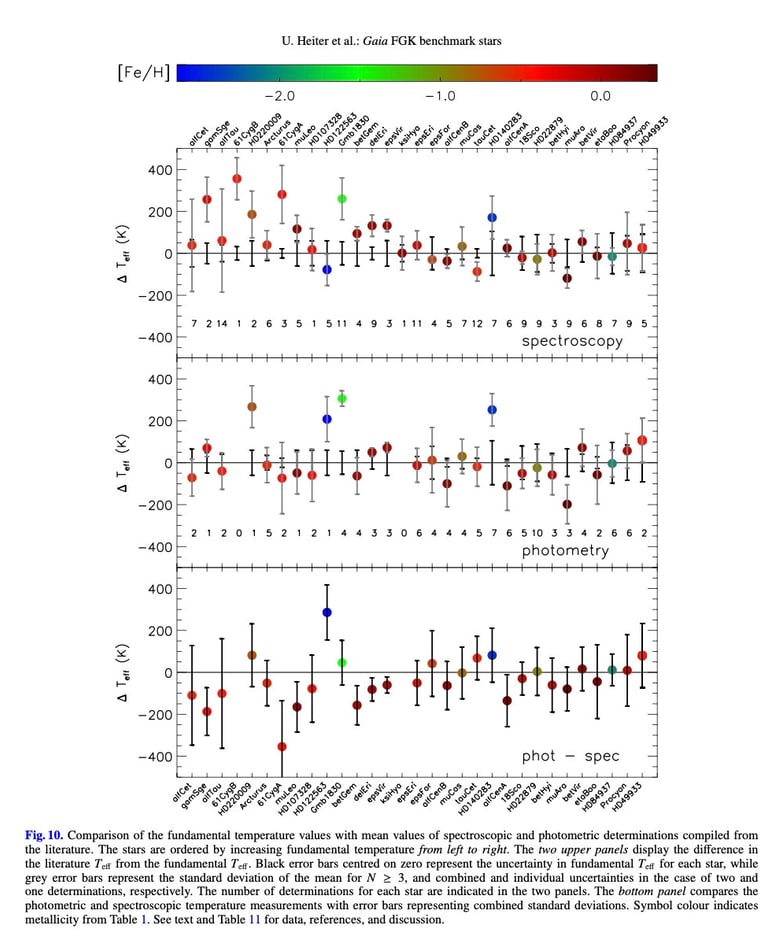
This is the introduction of the first sample, the GBSv1. The paper describes the selection criteria for the stars, and how the parameters are derived. It further provides recommendation of which stars can be used for reference, and suggests stars for new angular diameter measurements which can be used for future GBS.
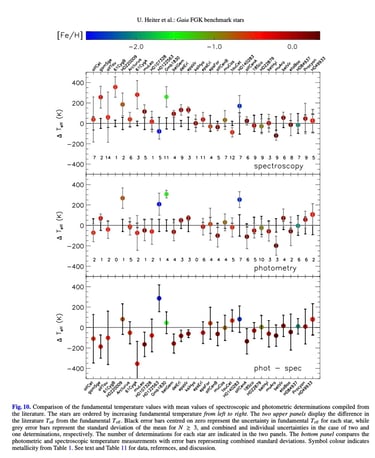
The figure shows how the effective temperatures obtained from the Stefan Boltzmann agrees with those derived from spectroscopic of photometric methods. Stars are sorted by temperature, from cool to hot. The figure demonstrates how spectroscopic methods still have to significantly improve for cool stars, and why having reference stars with temperatures derived from fundamental methods is important for improving spectroscopic methods.
Paper II: The Gaia FGK benchmark stars. High resolution spectral library
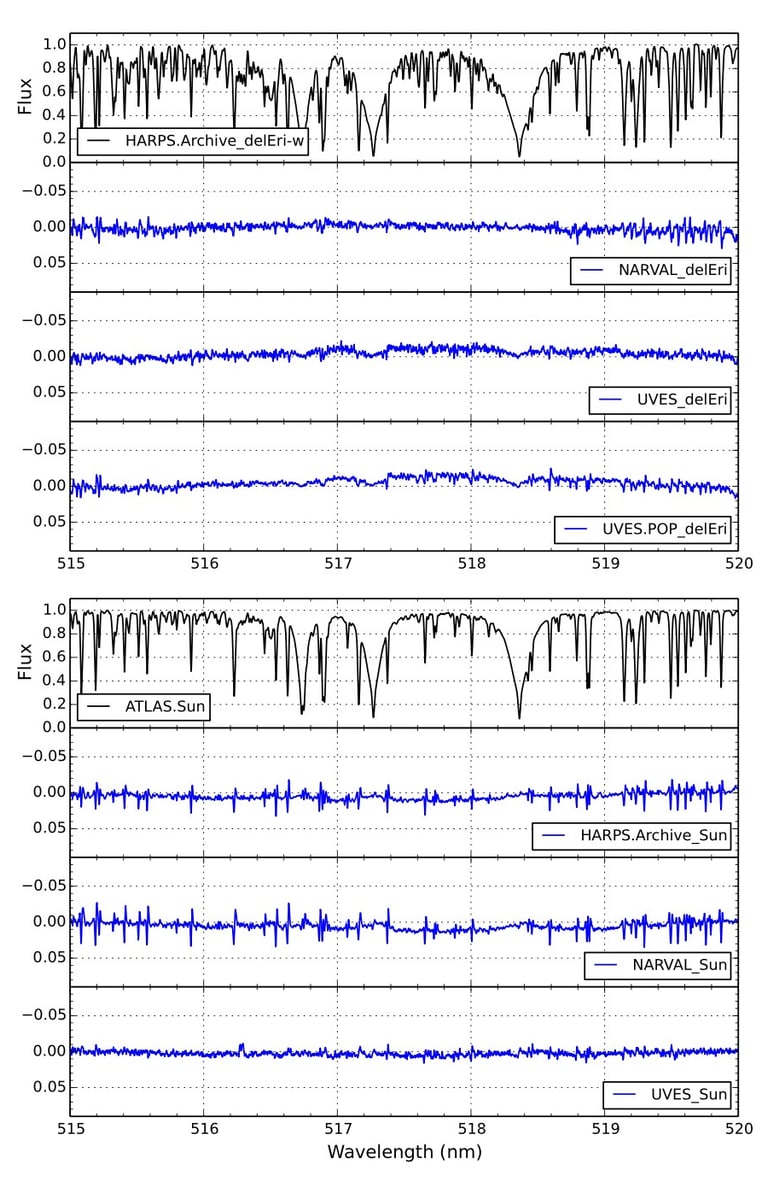
This is the introduction of the spectral library of the GBSv1, which consists on a collection of archival data for all stars from different instruments (HARPS, UVES, NARVAL). The data has been curated and homogenized (corrected by radial velocity, normalized, convolved to common resolution, etc)
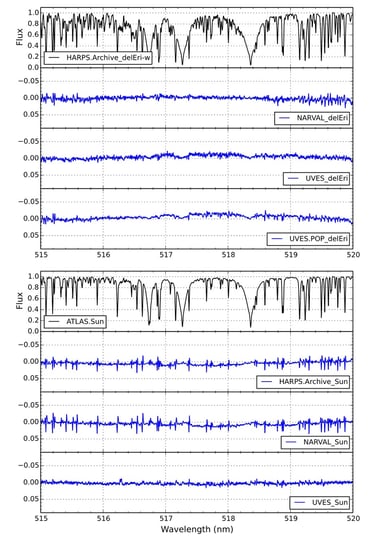
The figure shows examples of two stars and the difference in fluxes for different spectra. The spectra can be downloaded from a dedicated website. The library has been extensively used for various spectroscopic analysis throughout the years, and became a fundamental resource for researchers who wish to learn spectroscopy on a range of stars.
Paper III: Gaia FGK benchmark stars: Metallicity
Jofré et al 2014, 2014A&A...564A.133J
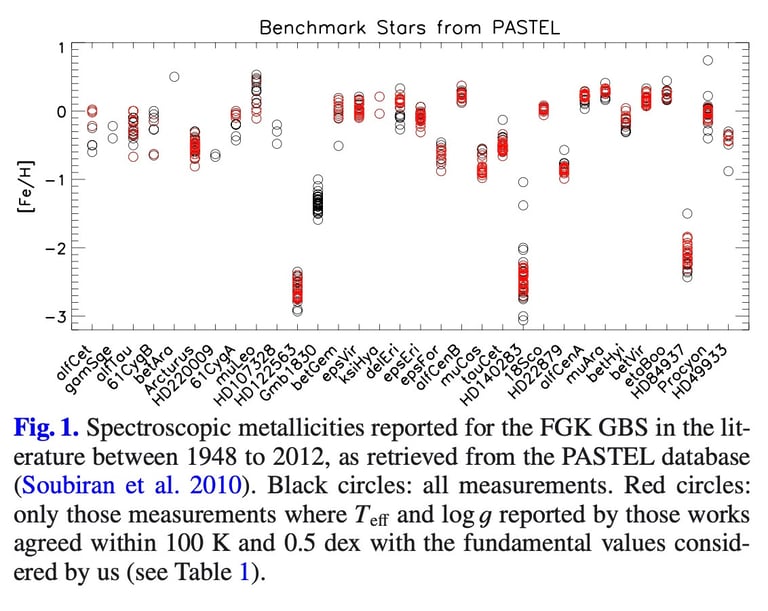
The paper presents the determination of metallicity using the fundamental parameters of PaperI and the curated spectra of Paper II. Several methods were compared and combined, providing an unbiased and homogeneous metallicity. This work is aligned with the strategy of the parameter determination of the Gaia-ESO Survey.
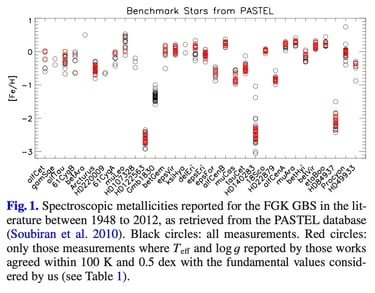
The figure demonstrates that even when the GBS are well-known stars, the literature provides a wide range of metallcities which comes from different methods, data and assumptions in spectroscopic analyses. Through the detailed analysis of the GBS we have been able to contribute not only to new reference stars, but to the overall discussion about how well do we really understand stars.
Paper IV: Gaia FGK benchmark stars: abundances of α and iron-peak elements
Jofré et al 2015, 2015A&A...582A..81J
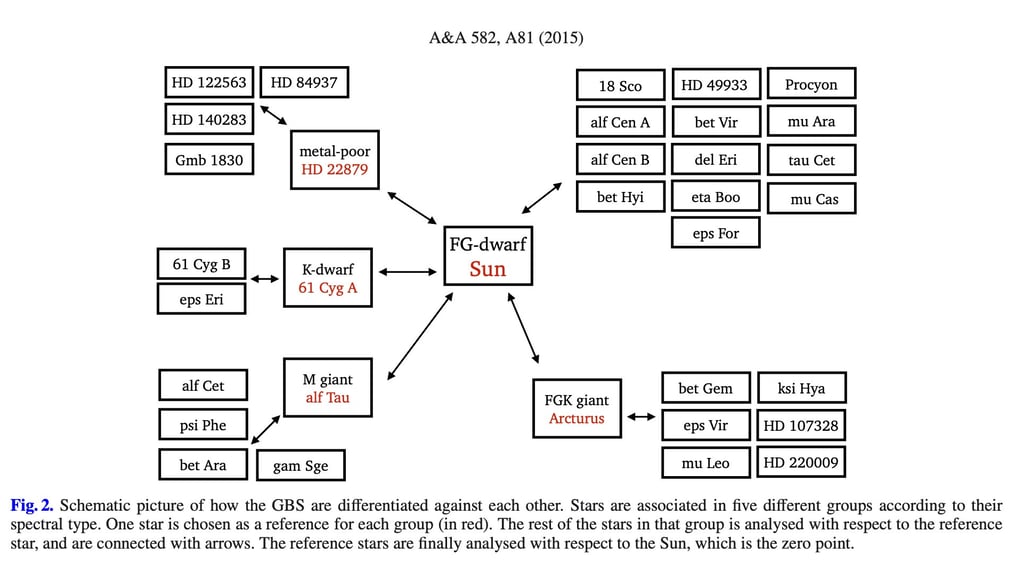
Abundance analysis of the GBSv1 using several methods, following the strategy of the Gaia-ESO Survey. The paper discusses the line to line and method to method dispersion for different stellar types and elements.
This figure shows that an homogeneous and precise abundance determination motivated one of the first attempts to group stars of different spectral class for differential abundance analysis.
Paper V: Gaia FGK benchmark stars: new candidates at low metallicities
Hawkins et al. 2016, 2016A&A...592A..70H
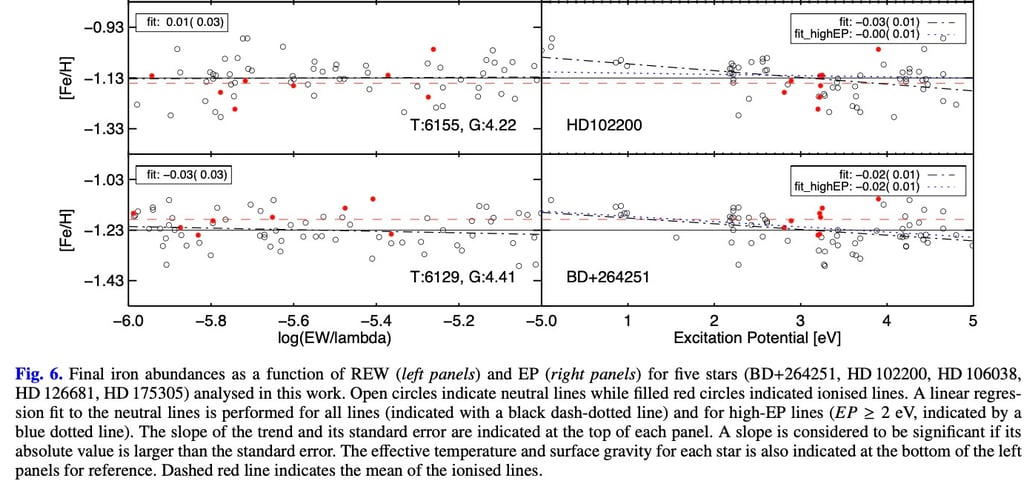
Since the GBSv1 included very few metal-poor stars, this paper introduces new candidates. These are not benchmark stars as their angular diameter was derived using surface brightness relations instead of directly determined from observations. Current interferometers do not allow to resolve angular diameter of many metal-poor stars, because their distances make their brightness and angular sizes small.
The figure shows the ionization and excitation balance of iron lines. When fixing temperature and surface gravity, iron lines present trends and differences which are due to Non-LTE effects.
Paper VI: Gaia FGK benchmark stars: opening the black box of stellar element abundance determination
Jofré et al 2017, 2017A&A...601A..38J
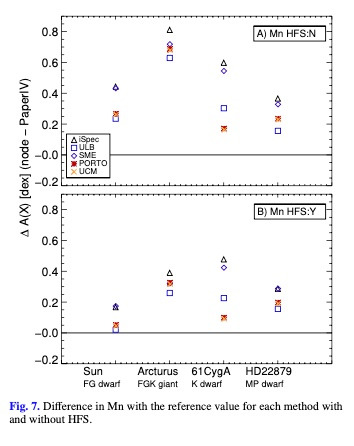
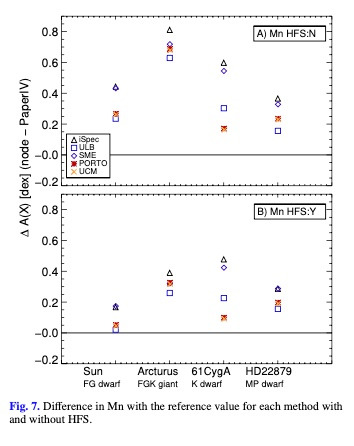
From Papers III, IV and V it became clear that the different spectroscopic methods provided different results which needed deeper investigation. This paper is the result of the first Gaia benchmark stars workshop organized in 2016, Cambridge (UK). Here we compared abundances of 4 different lines/elements/stars by varying systematic input decisions in each method.
The figure shows the impact of hyperfine structure splitting (HFS) of Mn abundances. While the abundances obtained under HFS:Y are systematically lower than the results obtained under HFS:N, the node-to-node scatter does not seem to significantly decrease. This also shows that even if HFS is taken into account, the abundances might be uncertain due to the HFS treatment, binning of the different components in the line list and the proper modelling of lines that strongly deviate from having Gaussian or Voigt profiles. The line under study, even in the case of the Sun, can produce 0.2 dex differences in abundances obtained by different methods.
The Gaia FGK benchmark stars version 2.1
Jofré et al 2018, 2018RNAAS...2..152J
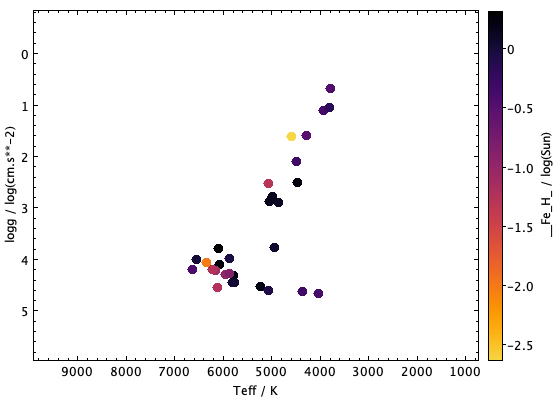
The addition of the metal-poor candidates from Paper V and the thorough assessment of good reference stars from GBSv1 motivated a clarification of our set of recommended GBS which we summarized as a catalogue GBSv2.1. The ".1" indicates that no new version of parameters was released in this version, but only the sample of stars was revisited. GBSv2.1 consisted in 32 stars, which can be directly downloaded from CDS. This paper is not peer-reviewed as it does not contain scientific analysis, and thus is not considered as part of the GBS series of papers, but it provides a useful summary catalogue of Papers I-V.
Paper VII: Gaia FGK benchmark stars: Fundamental Teff and log g of the third version
Soubiran et al. 2024, 2024A&A...682A.145S
Presentation of the GBSv3, which improves in several ways compared to GBSv2.1. Thanks to the better parallaxes from Gaia, the new angular diameters available in the literature, and new photometric data for stars, this new sample provides stellar parameters determined more precisely and homogeneously than before. The sample also increased in order of magnitude in terms of number of stars.
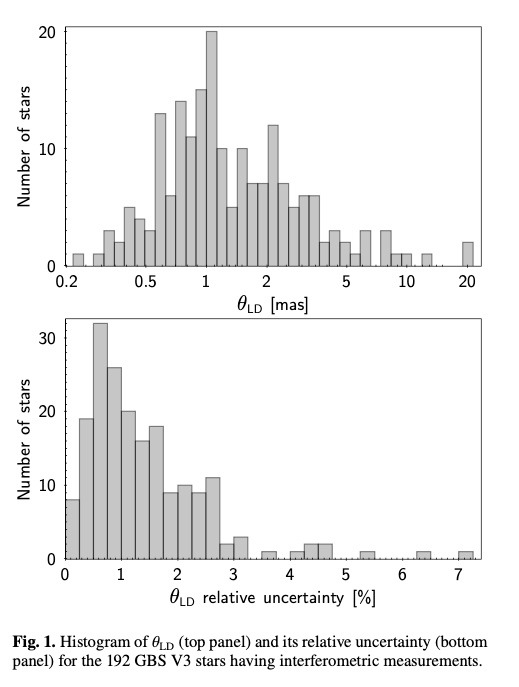
The figure shows the distribution of angular diameters and their uncertainty used for the stellar parameters of the GBSv3. Unlike in GBSv2.1, here only for metal-poor stars we made an exception to consider angular diameters from surface brightness relations. Otherwise all stars have a precise angular diameter determination from the literature.
Paper VIII: Gaia FGK benchmark stars: Spectral library and abundances of α and Fe-peak elements of the third version
Casamiquela et al 2026, 2026A&A...705A.167C
In this paper we present the spectral analysis of the GBSv3, and release a spectral library of about 1000 high resolution spectra for the 200 stars. We followed our previous analysis of deriving abundances by fixing the stellar parameters to the fundamental values. The paper includes several comparisons of spectra and methods, to have a good assessment of the uncertainties of the final abundances.
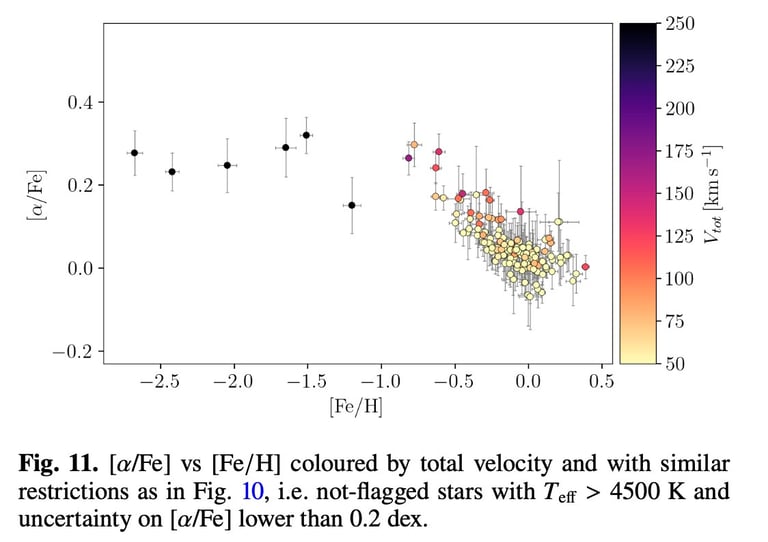
This figure is a nice representation of the GBSv3 in Galactic context. The diagram hows that the most metal-poor and alpha enhanced stars have higher velocities. The GBSv3 do not only cover well the parameter space in the HR diagram, it also samples different populations of the Milky Way. We see, however, that metal-poor and alpha-enhanced halo/thick disk stars are rare compared to the metal-rich and alpha-poor think disk stars.
Paper IX: Gaia FGK benchmark stars: abundances of n-capture elements of the third version
Vitali et al 2026, 2026arXiv260523786V
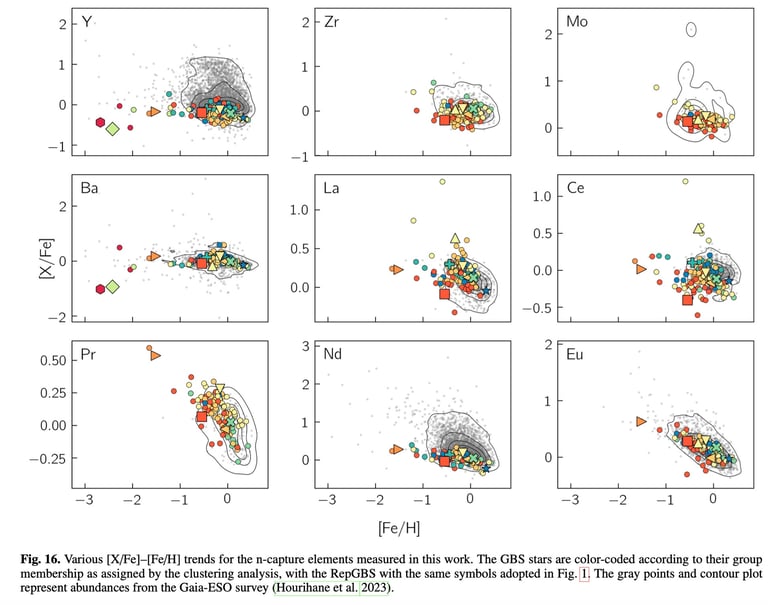
We present the first homogeneous determination of neutron capture abundances of the GBS. Given the huge variety of spectral lines available for different spectral types, we separated the stars in group to assess the quality of the lines, and replicated that assessment to all stars in the given group.
The figure is the distribution of the neutron-capture elements analyzed in this work, alongside with the abundance planes of the Gaia-ESO Survey as contours.
Paper X: Gaia FGK Benchmark Stars: Selecting Infrared Lines for Abundance Determination
Elgueta et al 2026, 2026A&A...710A.111E
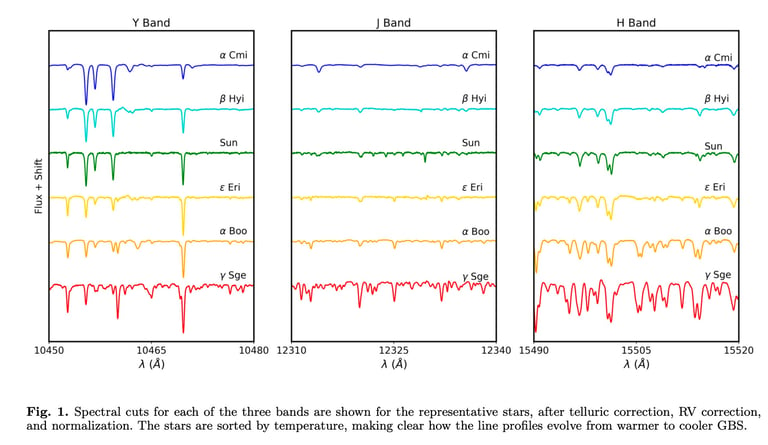
We are collecting CRIRES+ spectra of the GBS to better understand the differences between optical and Infrared abundance determination. This paper, the first one on GBS abundance analysis in the Infrared, explains a methodology to identify the spectral lines that are suitable for abundance determination for FGK type stars in the Y, J and H bands.
The figure shows spectral windows in the Y, J and H bands for different kind of stars.
Paper XI: Gaia FGK Benchmark Stars: Impact of Spectral Resolution on Stellar Abundances
Hernández-Araya et al 2026, 2026arXiv260525912H
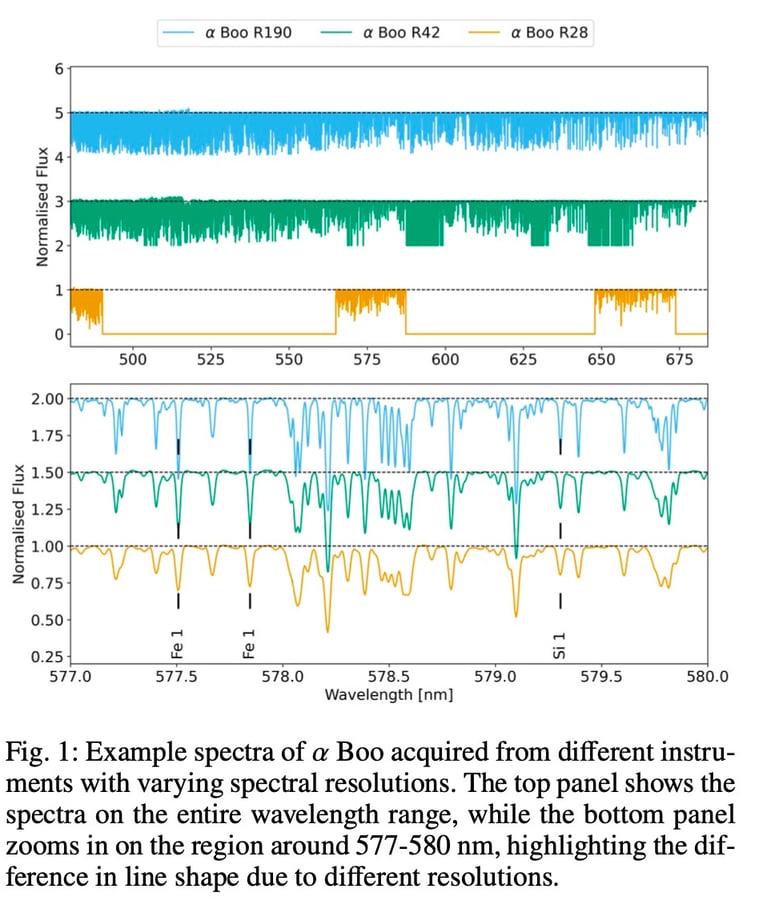
This paper uses the GBS to investigate spectroscopic methods. In this case, we studied the impact on derived stellar abundances determined from spectra of different resolutions. In this paper, compared ESPRESSO, the library of the GBSv3 and GALAH data. We found that abundances derived using synthesis methods were not significantly affected, while abundances derived using equivalent widths had a larger impact for the lowest resolution.
This figure shows example of spectra used in our work. As resolution decreases, lines become more blended. Synthesis can capture the blend, unlike equivalent widths.